There is no reliable duration from floor area alone
The duration of K&T replacement depends on the circuit scope, access, occupancy, equipment changes, inspection stages and finishing work. A useful schedule separates assessment and approvals from installation and restoration. Without those details, a fixed number of days can be misleading even when the house size is known.
Watt Cleveland Knob and Tube offers and manages older-home electrical work in Cleveland and nearby communities. Electrical work is performed by fully licensed and insured contractors.
Two houses with similar floor area can have very different routes and room arrangements. One may offer open attic and basement access, while another has finished spaces and alterations blocking those paths. Ask the contractor to explain the actual sequence rather than use a general timeline as a promise for your property.
Assessment and scope come before the installation calendar
A visible finding may not establish how much wiring remains active. An assessment can identify affected circuits, accessible transitions and unresolved concealed conditions. If further access or tracing is needed, that work may affect both the proposed scope and when installation can be scheduled.
Prepare the existing inspection report, insurer wording and previous electrical records to make that stage more useful. The contractor needs to understand whether the goal is a defined partial replacement or retirement of the remaining legacy system within the property scope. A schedule prepared for the wrong endpoint is not improved by making its dates more precise.
Access conditions affect the working sequence
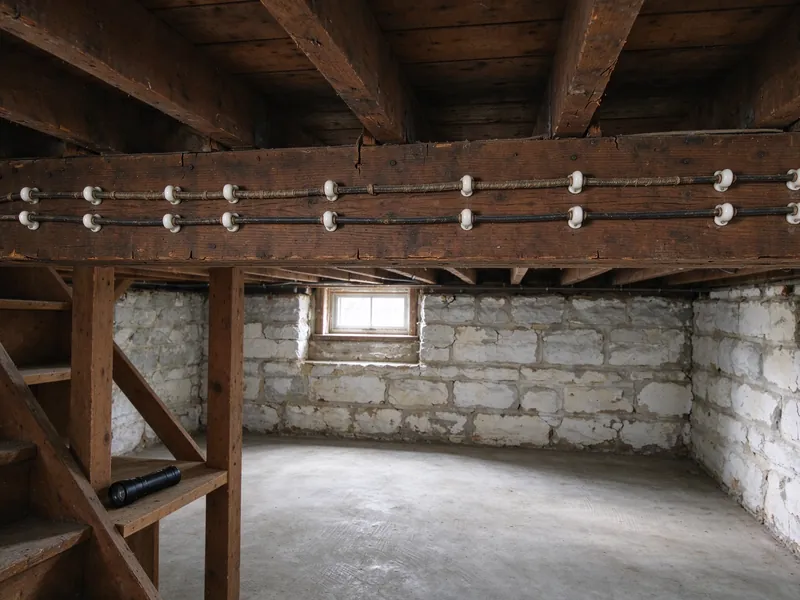
An accessible basement can provide a route into first-floor rooms, and an attic may help with upper-floor lighting. Neither guarantees access everywhere. Blocking, additions, finished attic spaces and previous renovations can change the approach. Planned openings may require coordination with a finish contractor.
Ask whether the estimate assumes certain routes are available and what happens if they are not. A discovery could require additional investigation, a different path or more restoration. The proposal should describe how the effect on cost and timing is discussed. That is more useful than a generic promise that no concealed condition can change the schedule.
Occupied homes need more than a completion day
Residents need to know which rooms must be clear, which areas require entry and how essential services are affected. Tell the contractor about heating, refrigeration, home offices and equipment relying on power. The scope should explain expected interruptions and any arrangements included in the work.
Do not assume that the entire home is without power for the whole installation period, or that every circuit can be restored every evening. The specific work determines those conditions. In a two-family building, access permissions and resident coordination can introduce separate dependencies. A useful schedule identifies those needs before the day a worker arrives at a locked unit or occupied work area.
Permits, inspections and utility appointments are distinct
Required approvals need to be coordinated with the work. Where an inspection is needed before concealment, the next trade cannot simply close the area because installation looks finished. Final inspection and permit closure may be another milestone. The relevant process must be confirmed for the property's municipality.
A service-equipment change can also involve the utility, while a branch replacement does not automatically need a service upgrade. Ask which appointments affect the critical path and who arranges them. The contractor can plan its own work, but another organization's appointment availability is not necessarily under its control. A proposed target should be distinguished from a confirmed booking.
Electrical completion and room restoration may be different days
The electrician may complete the agreed installation before plaster repair and painting are finished. Basic closure, surface matching, drying, preparation and decoration can involve a separate sequence. Those tasks should be included in the project discussion if the owner is asking when the house returns to normal use.
Ask what the contract's completion language means. Does it refer to installed circuits, required inspections, patched openings or decorated rooms? If another trade handles restoration, agree its handoff and access needs. Planning only around the electrical installation period can leave an owner with a working system but unfinished rooms for longer than expected.
Work backward from the real deadline
An insurance request, purchase or insulation project may set a desired endpoint. Share the exact requirement and ask whether the proposed sequence can support it. An insurer decides whether it accepts records or extends a deadline, while the municipality administers its own inspection process. No single contractor promise replaces those decisions.
Watt Cleveland Knob and Tube offers and manages the electrical project through fully licensed and insured contractors. Begin with the building, known findings and the deadline that matters. A useful proposal can then explain the expected installation sequence, unresolved dependencies and restoration responsibilities. Keep room for honest uncertainty rather than assuming a generic range guarantees the day everything will be complete.
Questions about this decision
Does a vacant house always take less time?
Not necessarily. Vacancy can make access simpler, but concealed routes, circuit scope, equipment and approval requirements still affect the work. The actual building matters more than occupancy alone.
Should I book insulation for the day after installation?
Confirm the electrical handoff and required inspections first. Installation, inspection approval and release to another trade may be separate milestones, especially where work must remain visible.
Can the contractor guarantee the insurer’s deadline?
It can describe the proposed work and schedule, but cannot guarantee the insurer’s decision or another organization’s appointments. Give the carrier accurate information and clarify requirements early.