The difference is in how the conductors travel
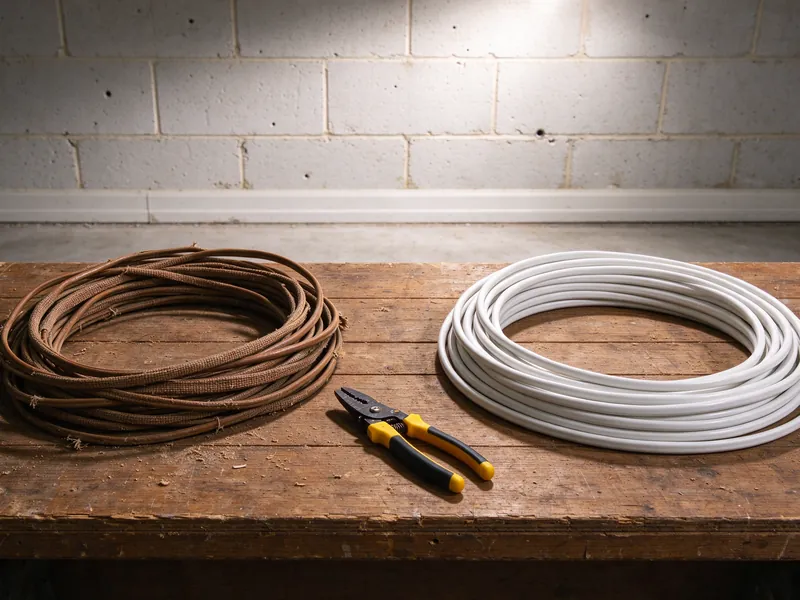
Knob and tube runs each conductor separately: a single insulated hot wire and a single insulated neutral, held apart on porcelain knobs and passed through framing in porcelain tubes. Cloth wiring usually means early sheathed cable, where two insulated conductors travel together inside one woven fabric jacket, stapled or clipped along the framing. Both used rubber insulation that can turn brittle, and both commonly lack an equipment ground.
Watt Cleveland Knob and Tube offers and manages older-home electrical work in Cleveland and nearby communities. Electrical work is performed by fully licensed and insured contractors.
The practical test, from a safe distance, is whether you are looking at two wires spaced apart or one flat or round cable. Fabric alone does not settle it, because K&T conductors also had a cotton braid over their rubber insulation. That shared covering is why inspection reports and listings often use the phrase cloth wiring loosely, and why the guide on identifying knob and tube treats the arrangement, not the texture, as the stronger clue.
How knob and tube was installed
Knob and tube was built as an open-air system. Installers drilled through joists and studs, set porcelain tubes in the holes so the wood could not chafe the conductor, and nailed porcelain knobs to framing where a run had to change direction or be held clear. Hot and neutral followed separate paths, often several inches apart and sometimes on different joists, and the space around them was expected to carry heat away.
Connections were made along the run. A tap to feed a light or receptacle was typically a twisted, soldered and taped splice made in open air, not inside a box. Where conductors entered a fixture or device, flexible loom tubing protected them. Because the hot and neutral were independent, later work could connect to either one wherever it was convenient, which is part of why heavily altered K&T can be difficult to trace.
How early cloth-jacketed cable was installed
Sheathed cable gathered the conductors into a single assembly. Early nonmetallic versions wrapped rubber-insulated conductors in paper or fabric and finished the outside with a woven braid, often treated with a protective coating. Armored cable, with its spiral metal jacket, was another option of the same general era and should not be confused with the fabric type.
This cable came into wide residential use over the middle decades of the twentieth century, overlapping the end of knob and tube and continuing after it. It ran along framing and terminated in boxes, so its connections were more often enclosed than K&T splices. Many versions had no grounding conductor at all; some later cable of this type did include one, though a ground wire inside the jacket only helps if it was actually connected at the boxes and the panel. The rubber insulation inside ages much the way K&T insulation does. Heat from light fixtures, past overloading and handling during renovations can leave it cracked and crumbling, sometimes while the fabric outside still looks intact.
Why both often turn up in the same house
A house built when knob and tube was the norm rarely stays electrically frozen. A kitchen added circuits, a basement was finished, a furnace or a second-floor bath needed power, and each project used whatever wiring method was current at the time. The result in many older homes is a layered system in which original K&T, later cloth-jacketed cable and modern grounded cable all serve different parts of the same building, sometimes on the same circuit.
The transitions between them deserve the closest attention. A splice joining K&T to newer cable may sit in a box, in a ceiling cavity or loose in an attic, and its quality depends entirely on who made it. Where a Cleveland-area house dates from the knob and tube era and has been renovated since, this kind of layering is plausible, but it still has to be established property by property rather than assumed from the year the house was built.
What each finding means for the scope
The distinction is not academic, because it changes what replacement involves. Knob and tube conductors run through framing on independent paths and often have splices in open cavities, so replacing them usually means designing new circuits rather than following the old routes. Cloth-jacketed cable already runs as an assembly into boxes, and its routes and box locations can sometimes guide where new cable goes, though the boxes themselves may be too small or unsuitable for grounded devices.
Insulation conflicts differ too. Open-air K&T raises specific concerns when insulation is blown around it. Older sheathed cable was installed as an assembly, but deteriorated rubber insulation inside the jacket is still a reason to have it assessed before an attic or wall cavity is filled.
Insurance and sale questions sometimes name one system and not the other. An underwriter's question about knob and tube is not answered by replacing cloth-jacketed cable alone, and replacing K&T may leave older sheathed cable in service elsewhere. A clear finding lets the scope, the price and the completion record use the same words. Cloth wiring replacement is a defined service of its own when the older cable is the concern.
What an assessment looks for
An electrician starts by identifying which wiring methods are present and where. In an unfinished basement or attic that may be visible: separated conductors on knobs, cable stapled to joists, or both. In finished rooms the evidence is usually at boxes, fixtures and the panel, and some of it stays concealed until a cover or ceiling fixture is opened as part of the professional assessment.
The next questions are whether each run is active, what it supplies and where the systems meet. Circuit tracing within a defined visit can connect a run seen in the basement to the rooms it feeds. The electrician also looks at visible insulation condition, signs of heat at devices and fixtures, overcurrent protection that does not match the conductor, and whether any grounding conductor in older cable is actually connected.
The written findings should keep the two systems separate: which circuits are K&T, which are older sheathed cable, which are modern, and which could not be determined without more access. That separation is what allows a partial project to be described accurately afterward.
What to do before the visit
You do not need to know which system you have before requesting an assessment. Gather what already exists: the inspection report wording, any photographs taken from normal access, records of past electrical work and notes on which rooms have two-prong receptacles or breakers that trip. Mention any planned insulation, renovation or sale, since each changes what the assessment needs to establish.
Leave the wiring alone. Old rubber insulation under either kind of fabric can crack when it is bent, and the outward appearance says nothing about whether a conductor is energized. Do not remove cover plates, pull on loose cable or move insulation to get a better photograph. If there is smoke, heat, scorching or visible arcing at a device, fixture or cable, stop using the circuit and call.
Watt Cleveland Knob and Tube offers and manages assessment and replacement of older wiring through licensed and insured contractors. Knowing where one system ends and the other begins is what lets a replacement plan account for access and restoration honestly.
Questions about this decision
Is cloth-jacketed cable safer than knob and tube?
Neither is safer by category. Cloth-jacketed cable keeps its conductors together and usually terminates in boxes, while K&T relies on spacing and open air. Both use aging rubber insulation and often lack a ground. The condition of the specific circuits, their connections and their protection decides the risk.
Can one circuit include both knob and tube and cloth-jacketed cable?
Yes. Later work often extended or repaired K&T circuits with whatever cable was current, so one circuit can change wiring methods partway along its route. The transition splices are a common focus of an assessment because their quality varies.
Does replacing the cloth wiring remove the knob and tube too?
Only if the scope includes both. The two systems can serve different circuits, so a project aimed at one can leave the other in service. The written scope and completion records should name each system and say which circuits were replaced.