Separate a visual clue from a confirmed finding
Knob and tube commonly appears as separate insulated conductors supported on porcelain knobs, with porcelain tubes protecting passages through wood framing. Those components are useful identification clues. They do not establish whether a conductor is active, what it supplies or whether the rest of the property uses the same wiring method.
Watt Cleveland Knob and Tube offers and manages older-home electrical work in Cleveland and nearby communities. Electrical work is performed by fully licensed and insured contractors.
Identification is usually the beginning of a decision rather than the decision itself. An inspection report may mention K&T because the inspector saw accessible supports in a basement. A renovation might reveal a single old connection. Both deserve a clear description, but neither proves that every room needs the same work. Have a qualified electrician identify the accessible system and explain what still needs investigation.
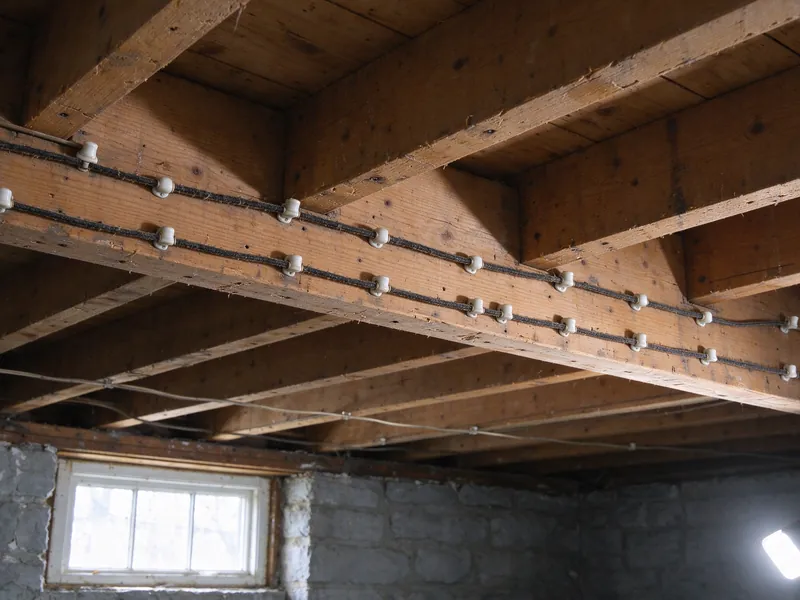
Look at the arrangement, not just the covering
The separated conductors distinguish K&T from later cable assemblies that group conductors together. A woven or dark outer covering alone is not enough. Several generations of wiring can have textile material, and an older house may contain examples of more than one system. Describing every cloth-covered cable as knob and tube can send the assessment toward the wrong scope.
Porcelain also has to be read in context. A support fixed to a joist may be a remnant of removed work. An old conductor can pass out of view before its connection becomes apparent. Modern cable nearby does not necessarily replace the older run. The electrician needs to understand the arrangement, accessible connections and relevant circuit routes instead of relying on one recognizable object.
Where the finding may appear
Basements, attics and renovation openings can expose parts of a system that finished rooms conceal. Ceiling fixtures and switches can also bring the issue to attention during work by an electrician. The location tells you where evidence was seen; it does not automatically describe the circuit's complete path.
A circuit observed below a room might serve that room, another floor or multiple areas. Alterations can change the arrangement over time. A finished attic can hide routes that an unfinished attic would expose. This is why a floor plan and a record of previous work are useful companions to photographs. They help frame questions about the whole building without assuming that room boundaries match electrical boundaries.
What you can share safely
Provide the report wording and any photographs already taken from normal, safe access. Describe where the objects were seen and what activity exposed them. If an electrician discovered wiring during another task, retain that person's written description. The distinction between suspected K&T, confirmed active wiring and disconnected material should stay intact when you pass the information along.
Do not remove device covers, unwrap connections, move insulation or pull wires to obtain a better view. Old insulation can be fragile, and appearance cannot establish electrical status. A photograph taken from farther away can still show useful building context. If the area is difficult to reach, tell the contractor about that access limitation rather than attempting to improve it yourself.
Ask the assessment to answer the next question
Once the method is identified, the useful follow-up is usually whether the wiring is active and what it supplies. That may require circuit tracing within a defined assessment. The findings should distinguish what was established through existing access from conclusions that would need further investigation.
If the report is for insurance, bring the carrier's exact written request. If it concerns a purchase, identify the decision you need to make before committing to work. An assessment sufficient to plan one renovation may not establish that an entire house has no active K&T. The visit's scope and its deliverables should match the objective, with limitations described in writing rather than concealed by a broad statement such as old wiring checked.
Turn identification into an appropriate scope
A confirmed finding can lead to assessment only, defined partial replacement or a broader replacement plan. Physical removal of abandoned material is another question. It should not be bundled automatically with electrical replacement, especially where removing concealed hardware would require extra openings.
Compare the result against your starting concern. If attic insulation prompted the visit, the electrical plan needs to address the affected attic circuits and the handoff to the insulation trade. If a panel was replaced previously, the findings need to establish the branch wiring separately. Watt Cleveland Knob and Tube offers and manages older-home electrical work through fully licensed and insured contractors. Share what was found and why it matters to you so the next conversation can focus on the actual building.
Questions about this decision
Can I identify K&T from cloth insulation alone?
No. Cloth covering appears on more than one older wiring method. The conductor arrangement, supports and accessible connections help identify the system. A photograph of dark cable should remain a clue until professionally assessed.
Does finding porcelain mean the wiring is live?
No. Porcelain supports and disconnected conductors can remain after rewiring. Electrical status requires professional verification. Do not touch, cut or test the material to find out.
What should an identification report include?
It should identify where the system was observed, what was established and the limits of access. If active status or circuit extent was not determined, that uncertainty should remain explicit rather than being converted into a whole-house conclusion.